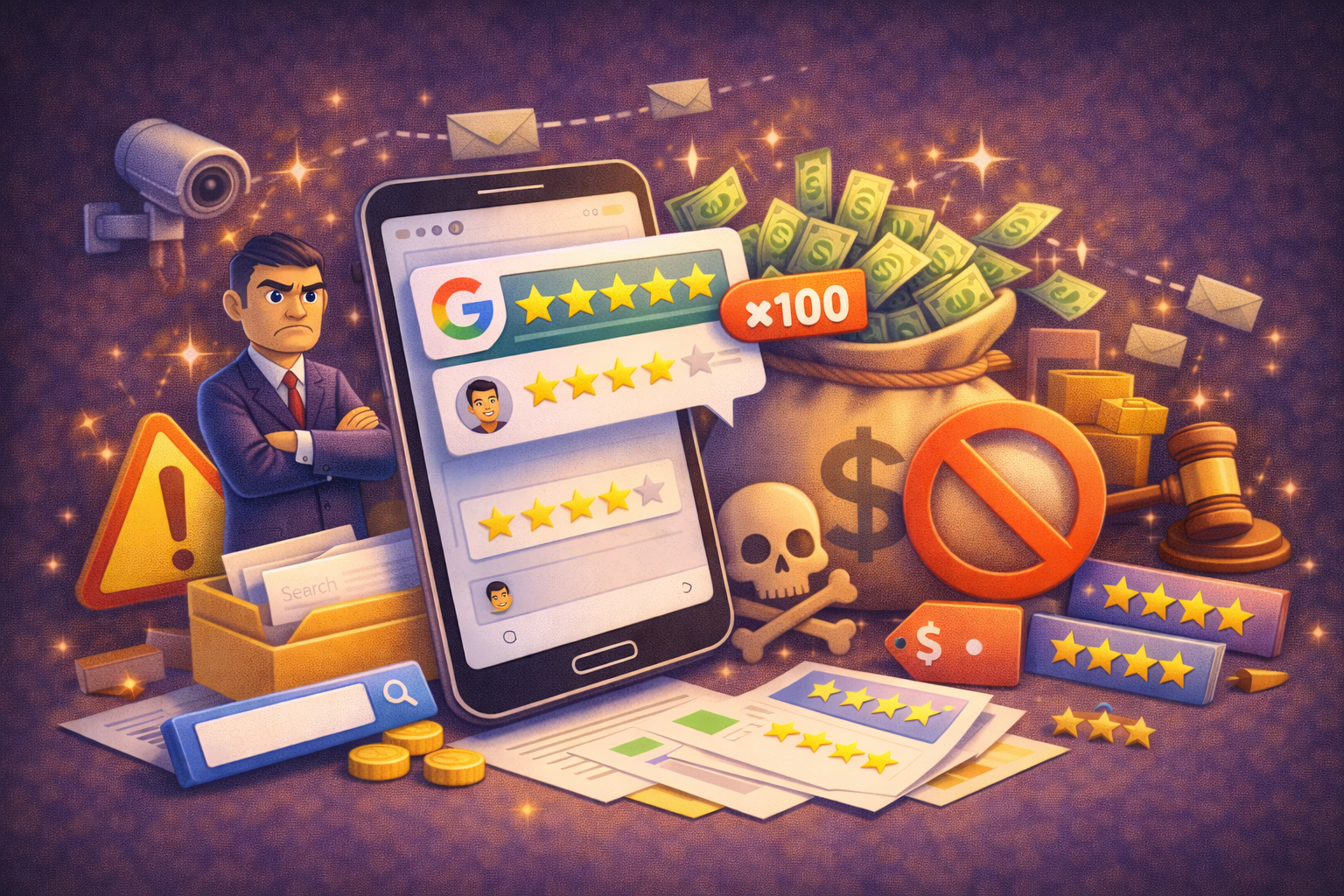
Your competitor has 200 five-star reviews while you're stuck at 15? The temptation to buy a few reviews to catch up is strong. After all, dozens of websites offer this service for just a few dollars per review.
Spoiler: it's one of the worst decisions you could make for your business. Here's why, and more importantly, how to get more reviews legally and sustainably.
in potential FTC fines for businesses caught using fake reviews in the United States
— Federal Trade Commission
What you're really risking by buying reviews
Buying Google reviews isn't just "frowned upon." It's illegal, and Google has increasingly sophisticated methods to detect this practice.
Your Google listing getting suspended
Google invests heavily in detecting fake reviews. Its algorithms analyze suspicious patterns: reviews from recently created accounts, sudden spikes in reviews, similar wording, connections from dubious IP addresses.
When Google detects manipulation, the penalty is immediate: removal of fraudulent reviews, and in serious cases, complete suspension of your Google Business Profile. You simply disappear from Google Maps and local search results.
Recovering a suspended listing is an uphill battle that can take weeks or even months. During that time, your customers can't find you.
Heavy financial penalties
In the United States, buying fake reviews violates FTC regulations on deceptive advertising. The FTC has increasingly cracked down on this practice, with penalties that can reach tens of thousands of dollars per violation.
In the UK, fake reviews violate consumer protection laws, with similar enforcement from the Competition and Markets Authority (CMA). The EU's Digital Services Act also imposes strict penalties for review manipulation.
Attention
In 2023, the FTC proposed a rule that would impose penalties of up to $50,000 per fake review. Several companies have already faced legal action for review manipulation, including settlements in the hundreds of thousands of dollars.
A disaster for your reputation
Let's say you slip through Google's and regulators' nets. What happens if a customer, competitor, or journalist discovers the deception?
In the age of social media, this type of revelation can go viral in hours. The trust you spent years building collapses in an instant. And unlike a bad service experience that can be remedied, cheating is unforgivable in the public's eyes.
How Google detects fake reviews
You might think a few purchased reviews will go unnoticed. Think again: Google uses advanced technology to spot fraud.
Behavioral analysis
Google analyzes the behavior of accounts that leave reviews. An account that leaves 50 five-star reviews in different cities in one week is immediately suspicious. "Review farms" often use the same accounts, creating detectable patterns.
Linguistic analysis
Google's algorithms analyze review content. Fake reviews often share common characteristics: generic wording, lack of specific details, similar sentence structures. Artificial intelligence spots these signals.
Temporal analysis
A business that suddenly receives 30 reviews in one week when it used to get 2 per month triggers an alert. Google knows that organic review growth is gradual, not sudden.
Geographic analysis
If your bakery in Chicago receives reviews from accounts based overseas or in distant cities, it's suspicious. Google cross-references account location data with your business location.
of fake reviews are detected and removed by Google within 7 days of posting
— Google Trust & Safety Report 2024
Common scams to avoid
The fake review market is riddled with scams. Not only do you risk penalties, but you can also get ripped off.
"Reviews from real local customers"
Many sellers promise reviews from "real local accounts." In reality, these are often hacked accounts or mass-created ones, easily detectable by Google. And even if the accounts are real, the review is still fake since the person was never a customer.
"Guaranteed reviews, refunded if removed"
Some sellers offer a money-back guarantee if reviews are removed. The problem: when Google removes fraudulent reviews, it also notes that your listing has been subject to manipulation. You might get your $50 back, but your listing is permanently flagged as suspicious.
"Review exchanges between professionals"
Some Facebook groups or forums offer review exchanges: "I'll leave you a 5-star review, you leave me one." This practice is equally forbidden and detectable. Google easily spots cross-reviews between businesses with no logical connection.
Attention
Fake review sellers are often scammers themselves. Payment without delivery, poor quality reviews deleted within 48 hours, subsequent blackmail... There's no shortage of testimonials from professionals who've been ripped off.
The legal alternative: getting more authentic reviews
Good news: there are perfectly legal methods to significantly increase your review count. And these authentic reviews are far more valuable than fake ones.
Why real reviews are more effective
An authentic review contains specific details about the experience. It mentions the salesperson's name, the product purchased, an anecdote. These details reassure future customers far more than a generic "Great, I recommend!"
Additionally, real reviews come in gradually and naturally, which Google rewards in terms of local SEO.
The problem: satisfied customers don't think about it
The reality is that your happy customers forget to leave a review. They appreciated your service, but once they're home, they move on to other things. Meanwhile, unhappy customers always find time to complain.
The solution isn't buying fake reviews. It's reminding your satisfied customers to share their experience.
of customers leave a review when asked, compared to less than 5% spontaneously
— Podium 2024
How to ask for reviews effectively
The most effective method is sending an SMS or email after each service. The message is simple: thank the customer and give them a direct link to your Google review page.
Timing is crucial: send the request when satisfaction is still fresh, typically within 24 to 48 hours after the service.
The problem with this manual approach? It takes time and discipline. After a few weeks, you forget, you postpone, and reviews stop coming in.
Conseil Reputacion
Reputacion fully automates this process. After each service, your customer automatically receives a personalized SMS with a direct link to your Google reviews. You don't have to do anything, and authentic reviews accumulate.
Reputacion vs buying reviews: the comparison
Let's put both approaches side by side to see which one is truly cost-effective.
Buying reviews
Cost: $5 to $15 per review, or $500 to $1,500 for 100 reviews
Risks: Listing suspension, fines up to $50,000+, reputation destruction
Durability: Reviews often deleted within weeks or months
Quality: Generic reviews without details that sound fake
Legality: Illegal (deceptive advertising)
Reputacion
Cost: $19/month, or $228 per year
Risks: None, 100% compliant with Google's guidelines
Durability: Permanent reviews that accumulate month after month
Quality: Authentic reviews with personal details
Legality: Perfectly legal
The math is simple: for the price of 15 to 30 fake reviews (which will probably be deleted), you get a year of a tool that generates dozens of authentic, lasting reviews.
Get more reviews, legally
Reputacion automates review collection from your real customers. Personalized SMS, direct link to Google, zero risk. Starting at $19/month.
Try for freeFrequently asked questions about buying reviews
Doesn't everyone buy reviews?
No. Many businesses with hundreds of reviews obtained them legitimately, simply by systematically asking their customers. The difference between a business with 20 reviews and one with 200 is often just having a collection strategy in place.
Can Google really detect a few purchased reviews?
Yes. Google's algorithms analyze millions of signals. Even 5 fake reviews create detectable anomalies: timing, geography, account history, wording. And once your listing is flagged as suspicious, all your future reviews are scrutinized more closely.
What if I ask my family or friends?
This is also prohibited by Google. Reviews must come from real customers who had a real experience. Google can detect connections between accounts (same IP address, Gmail contact circle, etc.).
Can I offer a discount in exchange for a review?
No, this is prohibited. You can ask for a review, but you cannot offer anything in return. The distinction is important: "Leave us a review" is allowed. "Leave us a review and get 10% off" is not.
Summary
Buying Google reviews is a losing bet every time. You risk suspension of your listing, fines that can reach tens of thousands of dollars, and destruction of your reputation if the fraud is discovered.
The right strategy is simple: systematically ask your real customers for reviews. With a 70% response rate when you ask (compared to 5% spontaneously), you can quickly catch up with and surpass your competitors, 100% legally.
Tools like Reputacion automate this process for you. For $19/month, you collect authentic reviews effortlessly, risk-free, and build a solid, lasting online reputation.
Don't gamble with your business. Invest in a legal solution.
Switch to authentic reviews
Stop risking your Google listing. Reputacion automatically collects reviews from your real customers, in full compliance with Google's guidelines.
Start free trial